Neuromorphic Computing and Proton-Toggling of Topology in Magnetic Multilayersat Osborne Center for Science and Engineering
Friday, September 4, 2026 at 11:00 AM MT · Arts · Colorado Springs, CO
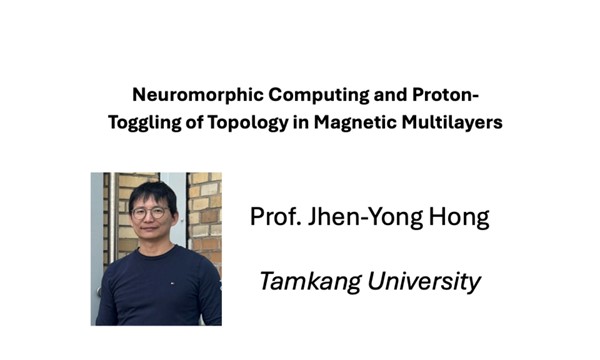
About This Event
For two decades, magnetic tunnel junctions (MTJs) have been vital in traditional computing memory and processing. Recently, innovative paradigms like probabilistic bits and neuromorphic computing have emerged as promising solutions for next-generation, unconventional computing devices. Driven by the pursuit of advanced functionalities, recent research has pivoted toward exploiting quantum phenomena—such as skyrmions—within diverse heterostructures and multilayers. Bridging these foundational concepts to implementations, this presentation first explores unconventional characteristics within magnetic systems. Specifically, we focus on charge stochasticity in traditional MTJs by analyzing bias-dependent noise data through the partition function, complemented by tight-binding model calculations [1-4]. This highlights the potential of MTJs as platforms for understanding charge stochasticity from a practical, device-level standpoint. Building upon these microscopic insights, the second part of this talk shifts focus to macro-level control, demonstrating how we can dynamically manipulate the magnetic properties and topology of ferromagnetic multilayers and synthetic antiferromagnets via voltage-free proton toggling. Finally, I will introduce state-of-the-art resources at synchrotron radiation facilities, both at my home institute in Taiwan and through worldwide collaborations. I will discuss how cutting-edge techniques—X-ray Magnetic Circular Dichroism (XMCD), Momentum Microscopy (MM), Scanning Transmission X-ray Microscopy (STXM), Angle-Resolved Photoemission Spectroscopy (ARPES), and X-ray Holography—serve as powerful tools to unveil the hidden magnetic and electronic structures of next-generation spintronic devices. References Nano Letters 25, 11776 (2025); Featured on the Journal Cover. “Stochastic Nature of Voltage-Controlled Charge Dynamics in AlOx Magnetic Tunnel Junctions” Sci. Rep. 14, 13664 (2024); “Bias polarity-dependent low‑frequency noise in ultra‑thin AlOx‑based magnetic tunnel junctions” Electronics 15, 2525 (2021); “Low-Frequency 1-f Noise Characteristics of Ultra-Thin AlOx-Based Resistive Switching Memory Devices with Magneto-Resistive Responses” Sci. Rep. 11, 6027 (2021); “Electrically programmable magnetoresistance in AlOx-based magnetic tunnel junctions” Hosted by: College of Letters, Arts and Sciences, Department of Physics & Energy Science, UCCS Physics Club Additional Information can be found at: https://mlc.uccs.edu/event/12662298
Event Details
- Date & Time:
- Friday, September 4, 2026 at 11:00 AM MT
- Address:
- A204
- Category:
- Arts
Map & Directions
A204
Frequently Asked Questions
- When is Neuromorphic Computing and Proton-Toggling of Topology in Magnetic Multilayers in Colorado Springs?
- Neuromorphic Computing and Proton-Toggling of Topology in Magnetic Multilayers is listed for Friday, September 4, 2026 at 11:00 AM MT.
- Where is Neuromorphic Computing and Proton-Toggling of Topology in Magnetic Multilayers being held?
- Neuromorphic Computing and Proton-Toggling of Topology in Magnetic Multilayers is at Osborne Center for Science and Engineering, A204 in the Colorado Springs area.
- How do I get tickets for Neuromorphic Computing and Proton-Toggling of Topology in Magnetic Multilayers?
- You can get tickets and find more information through the official event page on uccs. Click the "Get Tickets / More Info" button on this page.
More Events at Osborne Center for Science and Engineering
Event information is sourced from uccs. Please verify details with the event organizer before attending.